A reading stack by Stewart Thomson
Three narrators you would recognize after one paragraph.
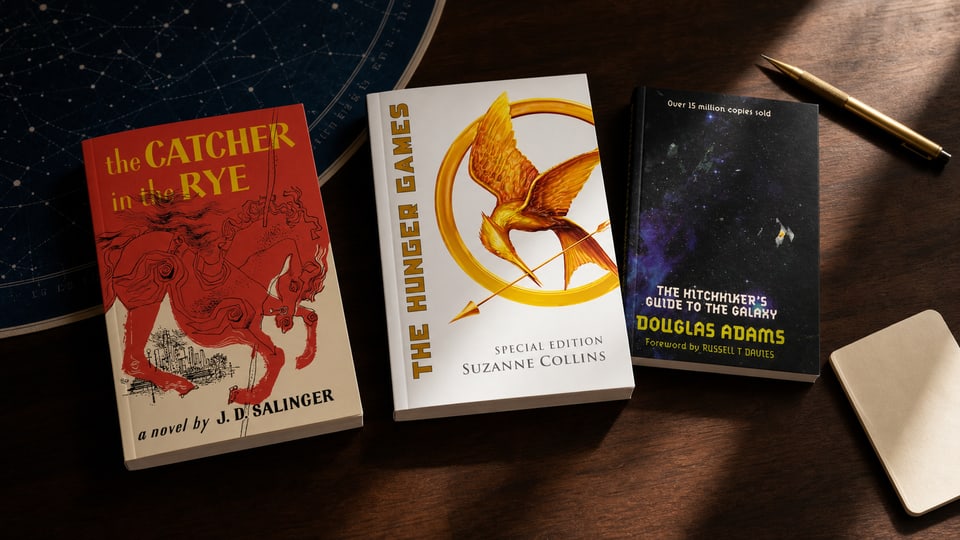
A prep-school exile. A girl on the morning of the reaping. A guide to a doomed planet.
The fastest way into a novel is often not the plot. It is the feeling that only this person could tell it this way.
Stewart Thomson chose three books whose voices became larger than their premises. One is confessional, one is spare and watchful, and one treats the end of Earth as a cosmic joke.
About the recommenderStewart Thomson is the author of Cydonia, a story about an apparently ordinary Scottish teenager and an orphan heir to Atlantis.
01
The Catcher in the Rye
J. D. Salinger · 1951
Holden Caulfield is one of literature's greatest creations: sardonic, often obnoxious, but always hilarious and entirely unique.
Stewart Thomson
Why the opening works
Holden begins by refusing the conventional autobiography the reader expects. The complaints, digressions, and judgments make his voice the event before the story starts.
02
The Hunger Games
Suzanne Collins · 2008
One of the most important young adult novels of all time that launched the Hunger Games series and propelled the character of Katniss Everdeen into icon status. Terrifying, apocalyptic, but always tinged with hope.
Stewart Thomson
Why the opening works
Katniss wakes and reaches for Prim. The reaping is named at the end of the first paragraph, but the protective instinct that will drive the book arrives first.
03
The Hitchhiker’s Guide to the Galaxy
Douglas Adams · 1979
The most hilarious apocalyptic novel ever written. Douglas Adams created an entire universe and had the most gleeful time in blowing it up.
Stewart Thomson
Why the opening works
Adams describes Earth from an absurdly distant perspective, then makes digital watches the measure of human progress. The scale of the joke teaches us how to read the universe.
04
Cydonia
Stewart Thomson
A self-described below-average Scottish teenager inherits his late father’s story about an orphan heir to Atlantis.
The book behind the stack
Why the opening works
Simon’s extra nostril appears in the first paragraph with complete matter-of-factness. The joke establishes the narrator’s warmth and the book’s appetite for the impossible.