A reading stack by Daniel Akst of Tivoli Books
Three unreliable narrators who make the truth more interesting.
A scholar edits a dead poet. A gourmet plans a journey. A wife writes from the road.
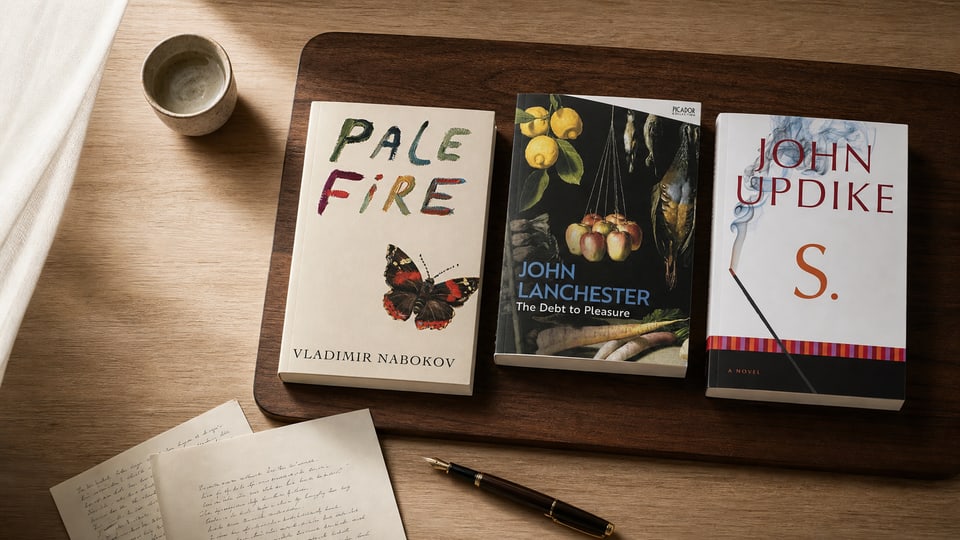
An unreliable narrator does not simply hide the truth. The best ones make you enjoy the hiding.
Daniel Akst, publisher of Tivoli Books, chose three novels whose voices are witty, educated, and not entirely safe to believe. Each recommendation is followed by its full Uncovered preview, so you can hear the voice before deciding whether to trust it.
About this stackDaniel selected these books to introduce The Florentine Papers, a novel by Thom Palmer published by Tivoli Books.
01
Pale Fire
Vladimir Nabokov · 1962
Like Florentine Papers, Nabokov's Pale Fire is droll, learned, and the tale of a somewhat unbalanced man of letters. There's a poet at the center of both stories.
Daniel Akst
Why the opening works
The poem begins with a waxwing striking a reflected sky. Shade turns the collision into an image of doubled worlds, establishing the pattern that the novel’s commentary will later distort.
02
The Debt to Pleasure
John Lanchester · 1996
This is a learned and witty and indeed wicked first-person novel that engages us with exquisite eccentricity.
Daniel Akst
Why the opening works
Tarquin Winot opens with a preface, a menu, and complete control of the conversation. The pleasure comes from noticing how elegance and menace occupy the same voice.
03
S.
John Updike · 1988
Another hilarious first person novel. This time our literate (and pedantic) narrator is a woman.
Daniel Akst
Why the opening works
Sarah writes to the husband she has just left. The letter form gives her total control over what he learns, while every domestic detail reveals more than she intends.
04
The Florentine Papers
Thom Palmer
A jilted muse writes his tell-all about a reclusive cookbook author.
The book behind the stack
Why the opening works
The narrator introduces himself as Maria Perpetua’s tester, taster, muse, and casualty. One paragraph establishes erudition, wounded vanity, and the comic grievance powering the book.