A reading stack by David Tracey
Three satirical novels that make absurdity feel true.
A tobacco spokesman. Christ’s forgotten best friend. A reporter sent to the wrong war.
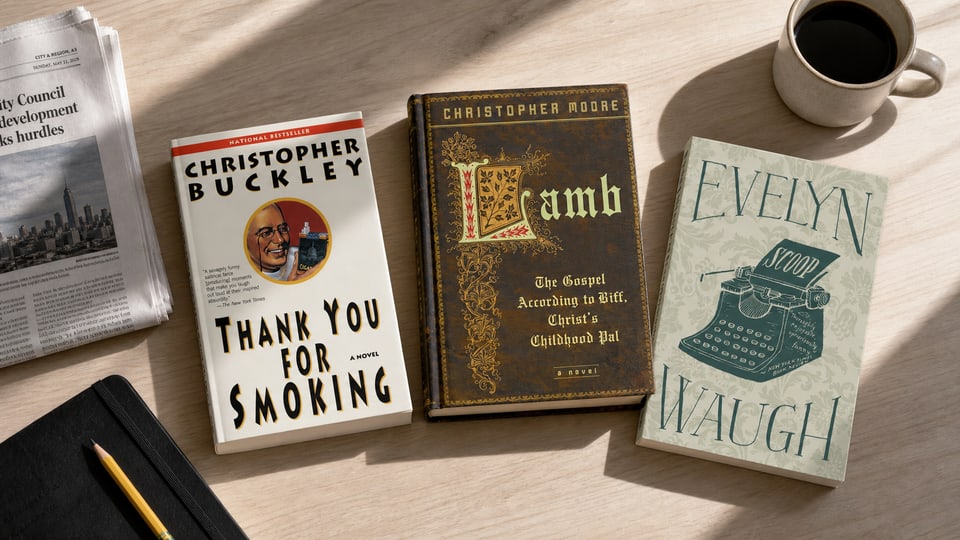
Satire works best when the world is ridiculous and everyone inside it treats the ridiculous part as ordinary.
David Tracey chose three novels that use comedy as a reporting tool. Their targets are public relations, religion, and journalism, but their first job is to make the reader laugh.
About the recommenderDavid Tracey is the author of The Miracle Tree, a novel about a rookie reporter and a tree said to grant wishes.
01
Thank You for Smoking
Christopher Buckley · 1994
Funny and barbed account of how seemingly regular folks can turn into creeps because of their day jobs, like pushing Big Tobacco.
David Tracey
Why the opening works
Nick Naylor enters through an enemy’s presentation slide, rendered as Satan in a cigarette-ad typeface. The joke gives us his job, his opposition, and the impossible room he must win.
02
Lamb
Christopher Moore · 2002
You can tell this is going to be hoot by the subtitle alone: "The Gospel According to Biff, Christ's Childhood Pal." Devoted Christians may even like it, unless they believe humour is the devil's business.
David Tracey
Why the opening works
An angel is cleaning glory out of a closet when a superior arrives with an assignment. Moore makes the divine bureaucratic in the first sentence, then keeps escalating the logic of the joke.
03
Scoop
Evelyn Waugh · 1938
The journalists' classic tale of a hapless foreign correspondent thrown into the deep end and somehow thriving. Telling the truth through absurdity.
David Tracey
Why the opening works
Waugh begins with a fashionable novelist, a family obligation, and a newspaper world that confuses names with confidence. The machinery of the mistake is funny before the plot has fully arrived.
04
The Miracle Tree
David Tracey · 2010
A rookie reporter is sent to cover a tree that grants wishes.
The book behind the stack
Why the opening works
The narrator steps off a punishing bus into a town that already feels slightly out of alignment. The dry observations establish a reporter’s eye before the impossible story appears.